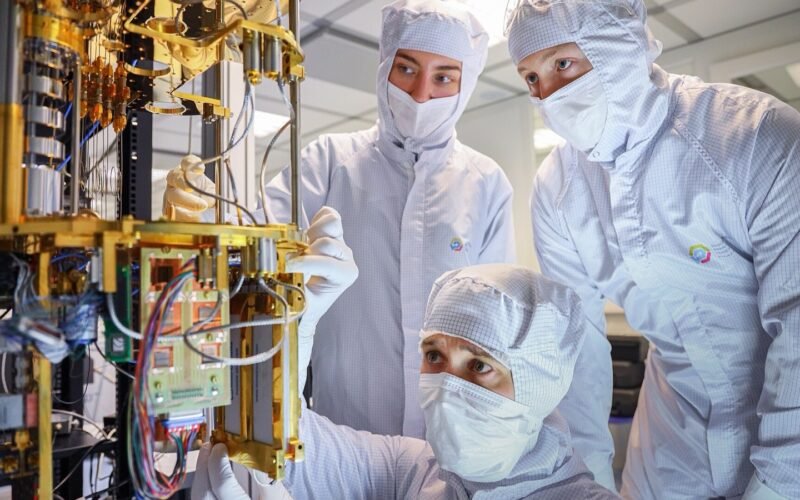
A superconducting neural-network chip has kept pace with fusion plasma data arriving at one million samples per second, according to Brookhaven National Laboratory, which led the test with chipmaker Great Sky, the Princeton Plasma Physics Laboratory (PPPL) and the DIII-D National Fusion Facility. The partners announced the result on October 19, 2026. No peer-reviewed paper has been published yet.
Fusion devices called tokamaks confine superheated plasma with magnetic fields, using a mix of algorithms, sensors and other controllers, Brookhaven’s release explains. The chip was tested on three tasks related to that control problem. Two used real data from the DIII-D tokamak in San Diego, which General Atomics operates: classifying anomalies and predicting disruptions, using algorithms from Brookhaven’s Computing and Data Sciences AI Department.
The third task used simulated data from TORAX, a tokamak simulator developed by the Google DeepMind fusion team, to predict the onset of sawtooth instabilities, which Great Sky describes as critical to tokamak operation. The DIII-D data were collected at one million samples per second, and “the chip had no problem keeping up with that speed,” according to Brookhaven. The lab says the result shows the chips could be used for real-time simulation of the plasma’s state, which it describes as central to tokamak control and stabilization.
A different kind of chip
Unlike central and graphics processing units (CPUs and GPUs), which use silicon transistors for digital processing, the chip implements analog neural networks using superconducting circuitry with optical communication, Great Sky says. Brookhaven describes the devices as first-of-a-kind chips “that mimic human brain networks using superconducting circuitry,” and calls them Super Intelligence (SI) chips. Great Sky manufactured the chip. “This is our largest chip to date,” said Jeff Shainline, the company’s founder and chief executive.
Great Sky spun out of the National Institute of Standards and Technology (NIST) after 12 years of research there, according to the company’s March 2026 launch announcement, which cited 23 peer-reviewed publications and eight patents. In that announcement, the company said its circuits are designed to behave like neurons rather than simulate them digitally, work at cryogenic temperatures and communicate using light, with signals it said can be as faint as a single photon. It also announced a $14 million seed round led by Bison Ventures.
Neither Brookhaven nor Great Sky has published the fusion-test chip’s latency, power consumption, operating temperature or neuron count.
Why it matters
Plasma control systems have to respond as conditions inside a tokamak change. PPPL director Steven Cowley said, “We are building the fusion machines of the SI era,” adding that such machines will need “control systems that think at the speed of a rapidly evolving plasma.” He said: “This chip took data straight from a tokamak at millions of samples every second and kept up.”
For the national laboratories, the work also ties several research programs together. Brookhaven director John Hill said, “Superconducting neural networks sit at the intersection of several DOE priorities,” naming advanced SI, quantum technologies and fusion energy. Shinjae Yoo, chair of Brookhaven’s Computing and Data Sciences AI Department and the project’s principal investigator, called the chip “a powerful, new platform for implementing many of the SI algorithms our team at Brookhaven Lab is developing.” Brookhaven is supported by the Department of Energy (DOE) Office of Science.
What to watch
DIII-D plans to integrate the chip and test it during its next experimental campaign. “We’re ready to integrate this chip and learn how it can impact diagnostics and control,” said DIII-D director Richard Buttery.
A larger chip is also planned, carrying a neural network 10 times bigger, though the two announcements give different timelines. Great Sky says it will demonstrate the next-generation chip in December. Brookhaven says the team expects to demonstrate it at Brookhaven in early 2027, followed by onsite deployment at the DIII-D tokamak later that year.
The caveats
The result comes from announcements by the participating laboratory and company, not from a published paper; Brookhaven says the team is working on a paper describing the work. Two of the three tasks used real DIII-D data and one used simulated data, and the chip has not yet been integrated into the tokamak’s control system, which is the next step the partners describe.
The announcements do not report accuracy figures for the classification and prediction tasks, or how the chip compared with conventional processors running the same jobs. Claims that the approach offers advantages in speed and energy efficiency come from the participants themselves; the announcements include no independent measurements.
Corrections and tips: email the editor using the address on the Contact page.