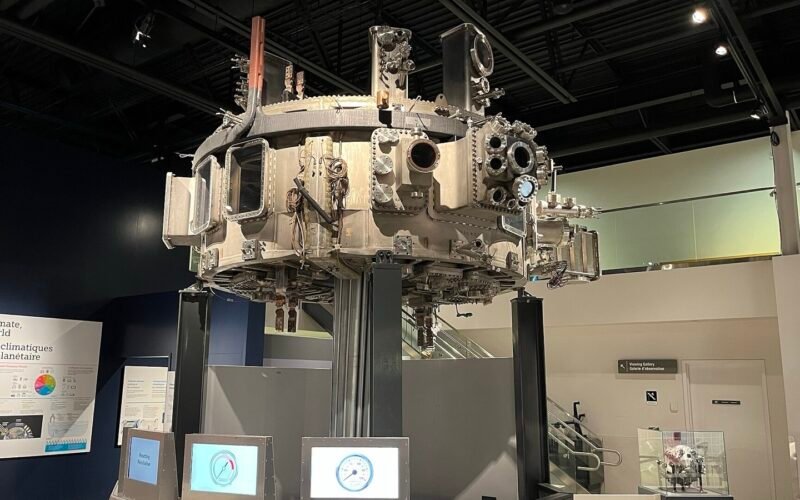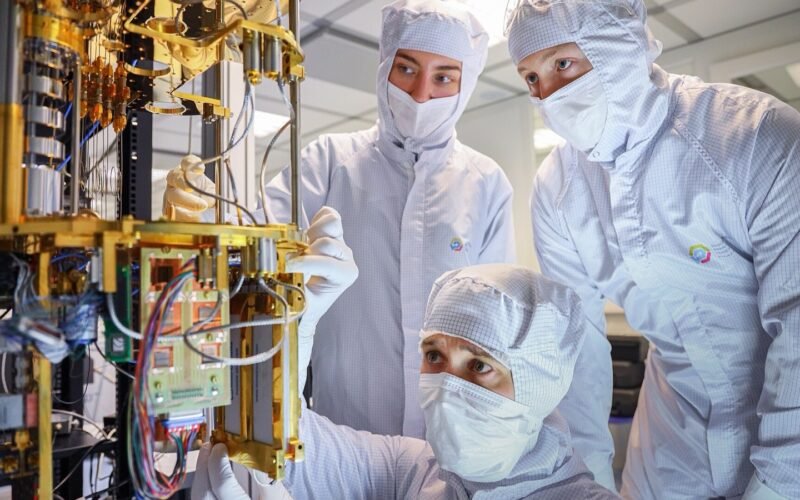
IBM researchers have linked two 120-qubit superconducting quantum processors with four 80-centimeter cables inside a single refrigerator, moving quantum states between the chips with an average fidelity of 99%. The company described the work on October 27, 2026, in a blog post about a preprint posted to arXiv on October 21, which has not been peer reviewed.
“Realizing the full potential of quantum computing requires us to scale to much larger quantum systems than exist today,” IBM writes, adding that bigger single chips alone will not be enough and that machines will need many processors passing information between them. IBM calls these long-range links between processors l-couplers, to distinguish them from the c-couplers that connect qubits on a single chip.
What was built
The experiment connected two IBM Quantum Nighthawk R1 processors, each with 120 qubits arranged on a square lattice, using four l-couplers. Each link combines about 80 cm of superconducting aluminum coaxial cable, a simplified, frequency-tunable “l-qubit” at each end and tunable couplers that join those qubits to the cable. The preprint’s 42 authors list IBM Research’s T. J. Watson Research Center in Yorktown Heights, New York, as their affiliation, and the setup was cooled to 20 millikelvin.
The cables run perpendicular to the chip surface and are attached with indium-to-indium pressure bonds made after both processor modules are mounted. In IBM’s earlier builds with a processor called Flamingo, the authors write, cables were joined parallel to the chip surface one at a time, and reliability and reproducibility were limiting. Although the chips are full Nighthawk processors, only a subset of their qubits was wired up for this development work, the blog notes.
The results
Transferring a quantum state from one processor to the other worked with a mean fidelity of 99.00% across the four links, the preprint reports, with the best link at 99.29 ± 0.07% and none below 98.86%. Each transfer took 256 to 312 nanoseconds. IBM says this is the first time superconducting quantum processors have been connected by multiple quantum channels with an average state transfer fidelity of 99%.
Two-qubit controlled-Z (CZ) gates between qubits on different processors, built from these state transfers, reached a mean fidelity of 94.75%, with the best link at 96.42 ± 0.28%. The team also used the links to entangle qubits across the two chips, including generating two Bell pairs at once over two adjacent l-couplers. One Bell pair reached a fidelity of 85.91 ± 0.40%, or 93.94 ± 0.27% after error mitigation. A six-qubit entangled state known as a GHZ state reached 67.67 ± 0.66%, or 90.87 ± 0.74% with mitigation.
The cable modes, near 5 gigahertz, had internal quality factors of 0.86 million to 1.09 million, values the authors say exceed the highest previously published for an assembled interconnect.
Why it matters
The preprint argues that splitting a machine into modules can pay off even when the links between modules have error rates “an order of magnitude larger” than gates within a chip, and that partitioning can cut the qubit overhead of error correction by an order of magnitude. IBM says the l-coupler design can scale to its planned fault-tolerant IBM Quantum Starling computer and beyond. The blog also notes that IBM debuted a new modular cryogenic platform for scaling quantum computers earlier this year.
Modular superconducting processors are also the approach IBM has taken into the US Defense Advanced Research Projects Agency’s Quantum Benchmarking Initiative (QBI), which aims to determine whether any approach can reach utility-scale quantum computing by 2033. On October 7, DARPA said IBM, Atom Computing, Diraq and IonQ had advanced to Stage C, the final stage, in which a government team tests whether proposed utility-scale systems can be built as designed and operated as intended. “Stage C is where we begin moving from plans to proof,” said Micah Stoutimore, QBI’s managing director.
The caveats
The work is a preprint and has not been peer reviewed, and it comes entirely from IBM researchers, some of whom list present addresses elsewhere. The authors say readout error was the dominant limit on the entangled states, and that qubit coherence was limited because fabrication steps known to improve it were skipped to speed up development.
They also describe the magnetic shielding braid around the cables as “a temporary solution,” say that bundling four cables in one braid likely lowered the quality factors, and note that the indium connections were not unplugged and remade in this work. Manufacturable methods for those connections are still under investigation.
What to watch
IBM says near-term work will focus on improving l-coupler yield and reproducibility, reducing error rates and “scaling to more l-couplers that can easily be plugged and unplugged between larger and more complex processors.” The authors add that building l-coupler elements directly into the qubit lattice would remove two state transfers and their local gates from each link, which they say would substantially increase fidelity between modules. The blog post gives no dates for these steps.
Corrections and tips: email the editor using the address on the Contact page.