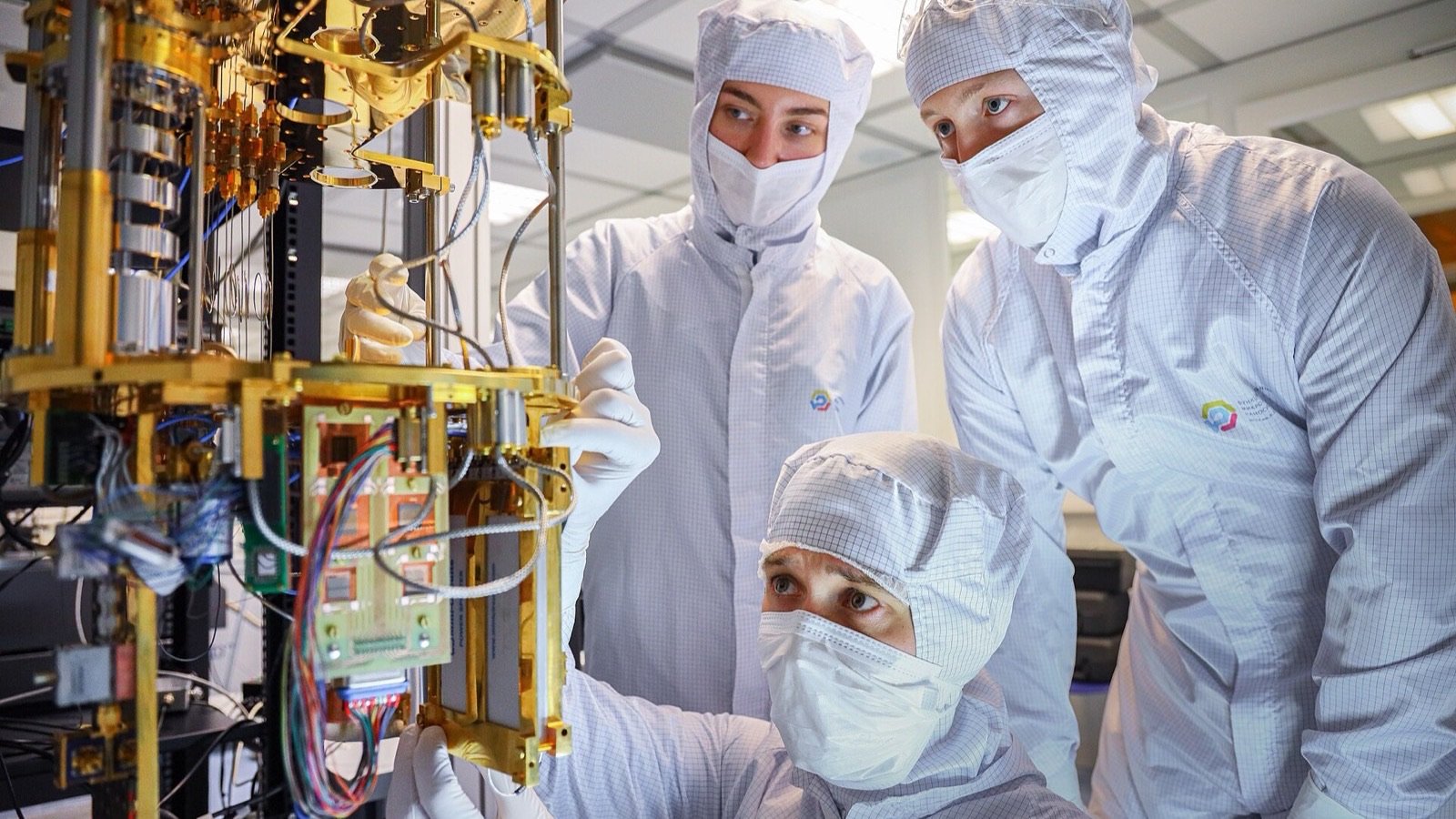
Quantinuum says it has run quantum error correction on its Helios trapped-ion computer with logical error rates as low as about five per million operations, a result the company calls a world record. It announced the result on October 19, 2026, three days after its researchers posted the underlying preprint to arXiv.
Error correction spreads one unit of quantum information across many physical qubits to form a “logical” qubit whose errors can be detected and fixed. The goal is for errors to fall as the code grows. The Quantinuum team tested three sizes of a scheme called the triangular color code, at code distances 3, 5 and 7, on Helios, which holds its qubits in trapped barium-137 ions.
The numbers
Each step up in code distance cut the logical error rate by a factor of 12 (+3/−2), the preprint reports. The authors define that factor, lambda, as the ratio of the code’s error threshold to the physical error rate. Over 20 rounds of error checking, the logical error rate per round was 5.5 × 10⁻⁴ at distance 3, 3.8 × 10⁻⁵ at distance 5 and 5 (+4/−2) × 10⁻⁶ at distance 7. Quantinuum’s release translates the best figure into a logical fidelity of 99.9995%.
According to the release, that error rate is 10 times lower than the company’s own record from September 2026, set with a different scheme called the Helix code on the same Helios hardware. The release also says it is 100 times lower than the best published result from another hardware type, which it identifies as a Google Quantum AI experiment on a superconducting processor.
The trade-off is size. Helix used 10 physical qubits per logical qubit, the release says, while the color code needs considerably more. The preprint lists 13, 37 and 73 qubits for the distance-3, 5 and 7 memory experiments.
The team also ran logical randomized benchmarking, a test of operations rather than storage. It reports an error of 7 (+3/−3) × 10⁻⁵ per logical two-qubit Clifford operation at distance 5, with a suppression factor of 9 (+8/−3) from distance 3 to 5. A distance-7 version was not run because Helios-1 does not have enough qubits, the authors write.
How it was done
A key problem was leakage, in which ions drift out of the two states used to store a qubit and then spread errors through later gates. The team combined a circuit-level fix with a hardware-level “repump” that uses light to return leaked ions to the qubit states mid-circuit. Three repump cycles suppressed leaked population 6.5-fold, and adding the repump improved the logical error rate fourfold at distance 3 and eightfold at distance 5, according to the preprint.
The authors compared four decoders, the software that infers which errors occurred. The most accurate, called Tesseract, is “generally not fast enough to be used in real time,” they write. A streaming decoder called Frontier can keep pace, and two neural-network decoders, one convolutional and one transformer-based, took about 0.22 to 0.52 milliseconds of graphics processing unit (GPU) time per round. The neural decoders were trained only on simulated data.
Why it matters
Quantinuum plans a universal fault-tolerant quantum computer called Apollo, which it expects to be available by 2029, and the release says this result puts its accuracy “within the target range” for that machine. Chief executive Rajeeb Hazra said the result shows the company has “the error-correction architecture and trapped-ion technology” needed for universal fault tolerance.
Robin Blume-Kohout, co-director of the Quantum Performance Lab at Sandia National Laboratories, who was not involved in the study, said in the release: “The paper demonstrates real, serious performance gains from quantum error correction.” He added: “These findings go a long way to retire one of the field’s central technical risks.” The authors suggest that scaled trapped-ion processors could reach useful performance with smaller code blocks than earlier results in other qubit types required.
The caveats
The work is a preprint and has not been peer reviewed, and all 23 authors are at Quantinuum. The headline numbers come from memory experiments that store information rather than run a full algorithm. All decoding was done offline, after the experiment, and the logical error rates were estimated from a single 20-round data point using an approximation rather than fitted across several round counts.
The authors leave below-threshold preparation of so-called magic states, and a full computation with real-time decoding, to future work. Quantinuum’s own forward-looking statements note that results achieved in experimental settings may not be replicated at larger scale or in commercial use.
Corrections and tips: email the editor using the address on the Contact page.