A total solar eclipse turns day into twilight for a few minutes along a narrow strip of Earth. This explainer covers why eclipses are occasional, what observers see at each stage of totality, and when the next total solar eclipses occur, using NASA’s dates.
1. Why eclipses are rare
A solar eclipse happens when the Moon passes between the Sun and Earth and casts its shadow on Earth, according to NASA. That can only occur at new moon, when the Moon and Sun sit on the same side of Earth. New moons come about once a month, but eclipses do not, because the Moon’s orbit is tilted by about five degrees relative to the plane of Earth’s orbit. Most months the Moon’s shadow passes above or below Earth.
Only twice a year, in so-called eclipse seasons, does the new moon cross that plane. Each season lasts about 35 days and repeats just short of six months later, according to NASA’s eclipses overview.
2. Why totality is possible at all
NASA calls it a cosmic coincidence: the Sun is about 400 times bigger than the Moon but also about 400 times farther away, so both look almost exactly the same size in the sky.
The Moon’s shadow has two parts. Inside the dark inner shadow, the umbra, the Sun is completely blocked; inside the fainter outer penumbra, it is only partly blocked. A typical umbral path may be less than 50 miles wide, while the penumbral zone can span a thousand miles or more. The shadow sweeps across Earth in four to five hours, so at any one place totality may last only a few minutes, or even less.
When the Moon passes in front of the Sun at or near its farthest point from Earth, the umbra does not reach Earth and a ring of sunlight remains: an annular eclipse. When an eclipse is total in some places and annular in others, NASA calls it a hybrid.
3. What happens, stage by stage
NASA’s guide to the stages of a total eclipse, written for the April 8, 2024, event, describes this sequence:
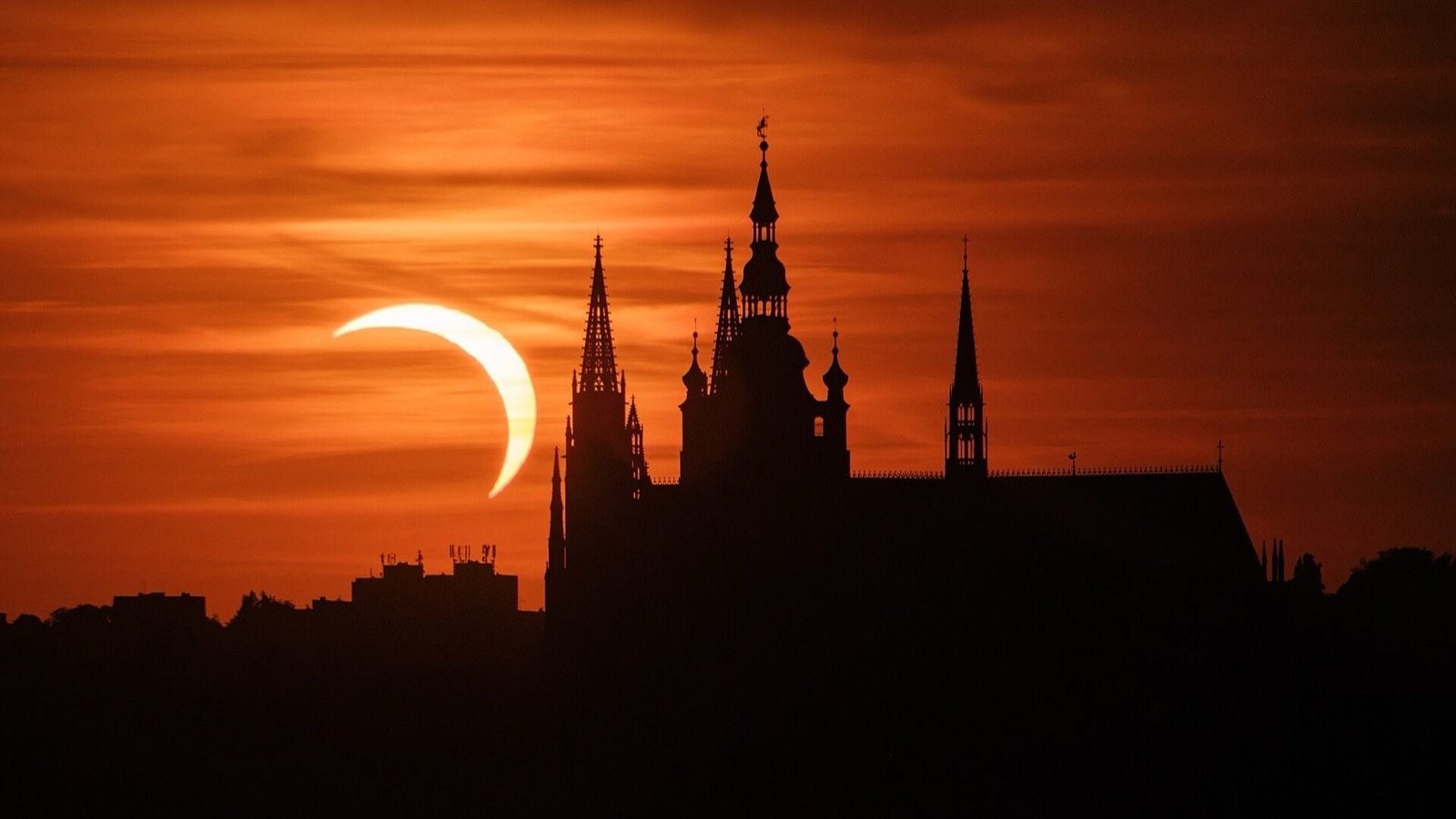
- Partial eclipse. The Moon begins to cover the Sun, which takes on a crescent shape. The moment the Moon first “touches” the Sun is called first contact. For most locations in 2024, NASA said, this phase would last 70 to 80 minutes.
- Shadow bands. Just before totality, faint, rapidly moving dark bands may ripple across the ground or walls, caused by turbulent air in Earth’s upper atmosphere distorting sunlight.
- Baily’s beads. Short-lived points of light shine around the Moon’s edge as sunlight streams through valleys along the lunar horizon.
- Diamond ring. The beads vanish until a single bright spot remains, resembling the diamond on a ring.
- Totality (second contact). With no direct sunlight left, the chromosphere may appear as a thin pink circle around the Moon and the corona as streams of white light. Observers may see a 360-degree sunset and bright stars or planets; the air temperature drops.
- Third contact and the reverse. Brightening appears on the opposite side, then the diamond ring, Baily’s beads and shadow bands return in turn. Fourth contact comes when none of the Sun is covered.
4. The next total solar eclipses
The most recent total solar eclipse was on Aug. 12, 2026. NASA’s Future Eclipses page, last updated Sept. 28, 2026, and the decade table on the NASA Eclipse Web Site, with predictions by Fred Espenak of NASA’s Goddard Space Flight Center, list the next ones as follows, with the table’s duration of totality at the point of greatest eclipse:
- Aug. 2, 2027 (total): visible, in NASA’s words, in “southern Spain, North Africa (including Morocco, Algeria, Tunisia, Libya, and Egypt), Saudi Arabia, and Yemen,” with a partial eclipse across most of Europe, much of Africa and the Middle East. 6 minutes 23 seconds.
- July 22, 2028 (total): totality in Australia and New Zealand, with the wider eclipse visible from Southeast Asia and the East Indies. 5 minutes 10 seconds.
- Nov. 25, 2030 (total): totality in Botswana, South Africa and Australia, with the wider eclipse visible from southern Africa, the southern Indian Ocean, the East Indies and Antarctica. 3 minutes 44 seconds.
The table lists no total eclipse in 2029, only four partial ones, and annular eclipses on Feb. 6, 2027, Jan. 26, 2028, and June 1, 2030. NASA says the next total solar eclipse visible in the contiguous United States will be on Aug. 23, 2044.
Common misconceptions
- “There should be an eclipse every new moon.” The Moon’s tilted orbit means its shadow usually misses Earth.
- “Totality lasts a long time.” NASA notes it may last only a minute or two in some locations.
- “Anyone in the region will see totality.” Only observers inside the narrow umbral path do; those in the penumbra see a partial eclipse.
- “An annular eclipse is a kind of total eclipse.” During an annular eclipse the Sun is never completely blocked; a ring of sunlight remains.
- “Sunglasses are good enough.” NASA states that eclipse glasses are not the same as regular sunglasses, and that regular sunglasses are not safe for viewing the Sun. Its eclipse pages set out the agency’s full safety guidance.
Corrections and tips: email the editor using the address on the Contact page.