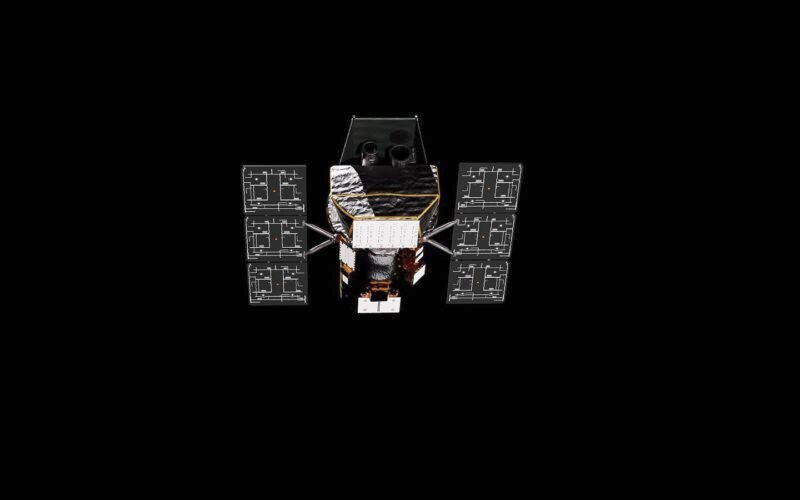
The European Space Agency’s (ESA) Euclid space telescope has discovered its first previously unknown comet, ESA said on Oct. 19. The object, now designated C/2026 S1 (Euclid), appeared in images taken between Sept. 16 and 24, 2026, and was confirmed as a comet by the International Astronomical Union’s Minor Planet Center (MPC) on Oct. 8.
The find was made by Mikko Pöntinen of the University of Helsinki, working with the Solar System Objects Science Working Group of the Euclid Consortium and using moving-object detection software he developed. “I was excited to see my software flag a ‘streak’ smeared across several images – the result of a fast-moving object,” Pöntinen said. By predicting the object’s position he found it in five image sets from the Euclid Deep Field North, with two to four exposures per view and 16 exposures in total. Closer inspection showed a fuzzy cloud around it, a sign of an active object shedding dust and gas.
Because no known comet or asteroid matched the object, the observations were reported to the MPC, and ground-based astronomers were alerted so they could make follow-up observations. The MPC’s Minor Planet Electronic Circular 2026-T146, issued Oct. 8, lists 54 observations made between Sept. 16 and Oct. 8 from 11 observing stations. They include Euclid itself, the Zwicky Transient Facility at Palomar Mountain, the Canada-France-Hawaii Telescope on Maunakea and a National Research Council of Canada station, along with seven other stations. Four observers, the first of them Pöntinen, reported a coma, the hazy envelope around a comet’s nucleus.
A distant, steeply tilted orbit
The comet is about 1.3 billion km from Earth, which ESA compares to the distance from the Sun to a point roughly between the orbits of Jupiter and Saturn. It does not travel in the plane of the planets. ESA says the comet is currently “straight up” from the Sun’s perspective, arching over the Solar System on an orbit that will take thousands of years to complete.
The MPC’s preliminary orbit gives an inclination of about 85.2 degrees and an eccentricity of 0.9956. The circular gives a perihelion distance, the closest approach to the Sun, of about 8.75 astronomical units (one astronomical unit is the average Earth–Sun distance), with perihelion around Sept. 2, 2027. ESA said the orbital period will be refined as more data are collected.
Why it matters
Euclid was not built to hunt comets. Its six-year mission is to observe billions of galaxies out to 10 billion light-years, and it deliberately avoids the asteroid- and comet-rich band of sky along the Solar System’s plane to reduce glare from dust that would hinder sensitive deep-sky imaging. Its “step-and-stare” strategy typically visits each section of the sky only once, so a comet cannot simply be revisited on demand to confirm its nature. “Very few comets are expected to be discovered by Euclid so it was a happy coincidence,” said Bruno Altieri, Euclid Archive Scientist and part of the discovery team, crediting the combination of the comet’s orbit and Euclid’s scanning over those days.
ESA said the quick turnaround between identification and validation shows that Euclid can detect new comets while they are still relatively far from the Sun, potentially supplying a target for its future Comet Interceptor mission. Altieri said this particular comet is not a suitable candidate for Comet Interceptor, but that the discovery and alert process gives the two mission teams a real test case for how they will coordinate. Valeria Pettorino, Euclid Project Scientist, said the team was happy to have found a previously unknown comet “for the Solar System community to follow-up on.”
Comets are icy, dusty leftovers from the birth of the Solar System about 4.6 billion years ago, ESA noted. The Euclid Consortium that analyzes the telescope’s data includes more than 2,000 scientists from 300 institutes in 15 European countries, the United States, Canada and Japan.
The caveats
The discovery was announced by ESA and confirmed through the MPC’s circular; ESA’s announcement does not cite a peer-reviewed paper. The orbital elements come from about three weeks of observations and are preliminary, and neither source gives an estimate of the comet’s size.
Corrections and tips: email the editor using the address on the Contact page.